When the ears receive nearby but different pure tones, some listeners perceive periodic fluctuations; the channel difference can be calculated accurately.
Whether particular differences reliably alter cognition, emotion or physiology remains affected by sample size, design and measurement differences, so no uniform benefit can be promised.
When each ear receives a slightly different tone, some listeners perceive an additional beat. It is an explainable auditory phenomenon, not proof of a fixed benefit.
Start with the auditory phenomenon
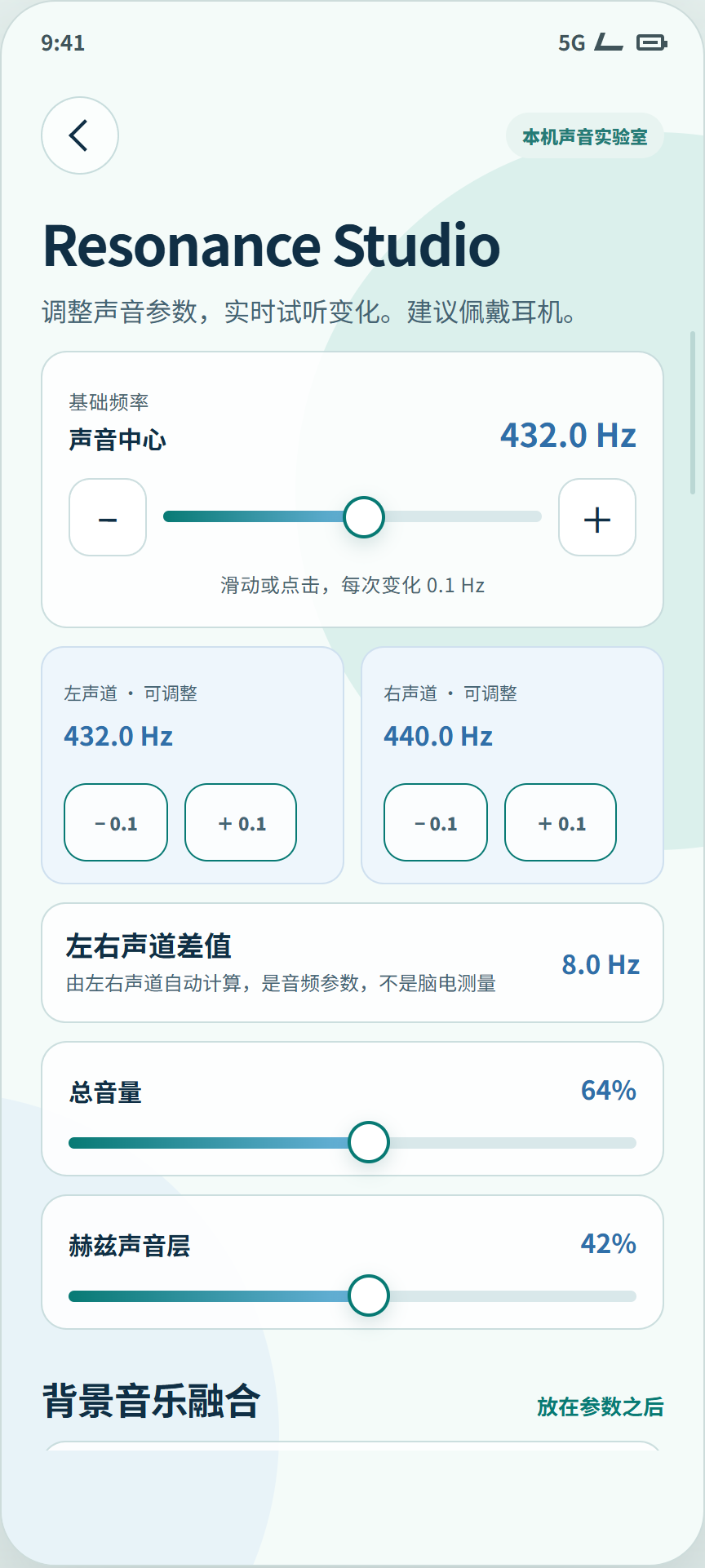
When the left and right ears receive close but different pure tones, a listener may perceive a slowly fluctuating beat. With 432 Hz on the left and 440 Hz on the right, the 8 Hz value is the channel difference—not a third tone playing in the air.[1]

Why studies reach different conclusions
A 2023 systematic review included 14 EEG studies: some reported changes aligned with the target frequency, while others found opposite or unclear results. A 2019 meta-analysis also found that outcomes varied with beat frequency, exposure time and timing.[2][3]
- Was the sample large enough?
- Was there a credible control condition?
- Did participants know what they heard?
- Was the outcome subjective or objectively measured?
- Was the analysis pre-registered?

Using it for personal listening
It is more useful to treat binaural difference as adjustable sound material: hold volume and setting steady, make small channel changes, then compare rhythm and timbre. With headphones, volume and duration come first.[4]

What we will not call it
Inner Resonance does not package a difference value as treatment or promise changes in disease, mood or wealth. The web Studio provides sound parameters, live listening and personal records.
References and primary sources
Links open research papers or institutional pages for further reading and verification.
- 01
How Do We Hear?
National Institute on Deafness and Other Communication Disorders · 2022
Basic explanation of the auditory pathway and conversion of sound into neural signals. - 02
Brainwave Entrainment by Binaural Beats: A Systematic Review
PLOS ONE / PubMed Central · 2023
Fourteen studies; highlights substantial variation in methods and findings. - 03
Efficacy of binaural auditory beats in cognition, anxiety, and pain perception: a meta-analysis
Psychological Research / PubMed · 2019
Twenty-two studies; discusses frequency, duration and timing. - 04
Deafness and hearing loss: Safe listening
World Health Organization · 2025
Guidance on volume, duration and safe exposure.
No thoughts have been saved yet
Begin with a question, a response or a different point of view.